Showing posts with label The great outdoors. Show all posts

Thursday, July 1, 2010

Yurting holiday

Dawdling in Kyrgyzstan is an almost entirely pleasant activity, even if its object (to wait out the violence down south) is somewhat less so. The reason for this is primarily because it is so easy to engage in said time-wastage in yurts up in the Kyrgyz mountains, which flicked in a day from spring to summer - morning drizzle gave way one day to bright afternoon sunshine that hasn't let up since. With this in mind, I coralled a trio of Swedes (travelling with Swedes is great: you learn the best Norwegian jokes) and we hired some horses and a guide to disappear for a few days into the hills in the centre of the country, where yurts sprout like mushrooms and there are ibexes (how do you properly pluralise an ibex? ibices?) on the mountain ridges and marmots (not marmosets. This caused a certain amount of confusion for a while) running shrieking at your approach.

I really can't get enough of the mountains here. Even when the horses are intransigent (Kyrgyz horses know damned well that foreign tourists have imbibed too much animal-welfare nonsense to follow the single piece of advice that constitutes riding instruction in these parts ("just hit it") with much conviction, and take full advantage of this, with the result that you frequently find yourself stationary in a patch of wildflowers for extended periods of time with the horse stuffing its face and you prodding it cautiously the whip, vaguely worrying that an RSPCA inspector is going to pop out from behind a rock and do you for animal cruelty, while the guide disappears over the horizon. Or possibly that's just me.) and the "saddles" appear to have taken their notion of comfort from a medieval torture chamber, everything feels fresh and bright and clean, with the high still covered with spring flowers and dozens and dozens of meltwater streams running off the hills. Wandering around the valley one evening I suddenly remembered what one is supposed to do when faced with a multitude of small streams and a large supply of flat stones and mud, and spent a very happy couple of hours damming and diverting several streams, and anyone who doesn't fully appreciate how supremely satisfying an activity this can be is probably dead inside.

Unlike the last time I was horse trekking here, this time we weren't particularly going anywhere, so we would do a bit of riding in the morning to get some nice views, then come back to the yurt, which is always very much a working place as well as somewhere for tourists to crash, so there were always small armies of daughters and nieces (it seems that a lot of families in the towns send their children to relatives in the country for their summer holidays so a lot of the kids up here now actualy spend most of the year in Bishkek) milking the cows and horses and making cream and fetching water and cooking, while the sons and nephews herded the goats and the cattle and we rather got in the way, but everyone was very nice and fed us neverending quantities of tea and kumis anyway (ah, kumis. The one (monumental) downside to yurt living. Have I waxed lyrical on the subject of fermented mares' milk before? Oh, I have. If someone in a yurt offers you a large bowl of slightly suspect-smelling white liquid with... bits floating in it, proceed with caution (see post immediatley below this one). I don't want anyone to say they weren't warned).

One afternoon, our host invited the neighbours (i.e. everyone who had a yurt within two hours ride) over for the Kyrgyz equivalent of a kickabout, which of course meant an enthusiastic game of kok-boru, the Kyrgyz national game which can be described as polo with a higher body count and which is played with the carcass of a goat. Compared to the full village-on-village clash I watched earlier this year, this was a more modest though no less chaotic affair, with half-a-dozen guys on each team as opposed to two hundred but an equal reluctance to confine the action to the pre-agreed playing field and feeling that nothing has been achieved until someone has been carried off unconscious (he woke up again in time for dinner, so that was OK). In the evening we ate goat kebab and fresh bread and cream and wild cherry jam by the light of oil lanterns while the Anglo-Swedish contingent strove to find an acceptable excuse for refusing the fourth bowl of kumis ( a partial list of what hasn't worked so far: I'm sick, it's against my religion, I'm lactose intolerant, I'm pregnant) and convincing defense for the inexplicable fact that despite the fact all of us were unmarried, none of us were imminently planning to rectify the situation, and the mountains turned pink in the sunset. I don't understand why everyone doesn't do this.

Monday, June 21, 2010

Kyrgyzstan again: a question of avalanches

What is it about this country that inevitably leads to me doing slightly silly things in pursuit of scenery? It's not as if it's hard to find the stuff here.

The pass was higher than I'd ever been in my life. The south side had been snow free, but the north was covered with overhanging snow bluffs, softened by the sun and the previous night's rain. A sentence I'd read once in a book about an avalanche disaster on K2 or some other such baleful mountain leapt to the front of my mind and lodged itself happily there, replaying again and again: "Strangely, the party had chosen to cross the snow field during mid-afternoon, the most dangerous time for avalanches". It was 2pm. Every ten minutes or so, a vast load of snow and rock rumbled off the neighbouring mountainsides, easily one of the most menacing sounds that there is. I probably wouldn‘t have been so concerned if our guide hadn't also been so very obviously Not Happy. “Too much snow, too dangerous”. With a rope or an ice axe the bluff would've posed no problems, but mountaineering equipment was just one other thing that we had not thought especially hard about. Of course, most people don't perish in avalanches. It's just that, well, some do.

The idea had been to do some gentle trekking in the hills around Karakol, in the east of the country. We had been informed by the head of the local trekking agency that there was a beautiful azure gem of a lake called Ala-Kol just two day’s hike away, and we could breeze up there, admire the Alpine scenery and breeze back down again. The pass crossing might be a little tricky because of the altitude he conceded (Oh ha ha, I thought bitterly, struggling to put one foot in front of the other at 4000 m), but there would be no snow, and we would be laughing our way down to the hot springs on the other side. Things we were not entirely aware of when we launched ourselves merrily into this enterprise: a) June still counts as spring in Kyrgyzstan, not summer and this had been the wettest and coldest June for a while and b) due to the unrest, we were the first group of tourists going up the pass this season. For a brief comparison, this is Ala-Kol as it usually looks in late June:

This is how it looked when we were there:

The similarities are, you must concede, striking.

We eventually scrambled down some snow-free boulders, which were vertical and unsteady in a way that lent new and intensely personal meaning to the phrase "rocks fall, everybody dies" and bolted across the snow as fast as we physically could, which was not very as it was up to our thighs, as one of the snow bluffs above us collapsed, sending a stream of snow and rubble past us slightly closer than I would've preferred. One slightly unexpected river crossing later (who knew that unstable ice sheets can harbour glacial streams underneath? Well, most people I suppose. I'm reasonably sure I've never uttered such high-pitched noises in my life) and we were down in a green, flower-filled valley, contemplating the uniquely ex-Soviet attitude towards health and safety. Actual mountain climbers do stuff like that all the time and at much higher, its just that they tend to have stuff like experience and equipment and some idea of what they're getting into. Evidently in Kyrgyzstan not much of this is important.

Still, the guy wasn't lying about the hot springs, and if there's one thing Kyrgyzstan is dead good for is hot springs. The thing to do with these is apparently to build a sanatorium on top and then depending on temperature either bathe in or drink the water, which of course cures everything, and everywhere you come across these decaying concrete complexes where cosmonauts used to convalesce and heads of state to meet and write constitutions and carve up new republics, and now they crumble gently but you can still get a two hour massage for five dollars. Fortunately the ones we stayed at that night were a bit too far away from anywhere for much of that, but there were still small concrete huts and huge baths smelling strongly of sulphur of which I got one of my own, because men and women sharing the same pool even while wearing bathing suits leads to the kind of moral degeneracy that even very smelly water can't cure. In the evening we talked politics, because now what else is there to talk about, and toasted to our survival and peace in the country with a bottle of vodka which had heroically survived being thrown over a cliff during our descent. It felt a little silly that here we were, wandering around scaring ourselves by having inept and mildly dangerous fun in the mountains, when everyone I speak to has a relative or friend in Osh that they're worried about, but then people are cancelling their holidays here in droves, and tourism is a major source of income in the rural areas, almost all of which are still safe, so we're probably not doing any actual harm.

Back in Bishkek now, keeping an eye on things and working out what to do next. Things are calmer now but tense, with everyone anticipating further trouble in the run-up to the constitutional referendum on June 27th. It will be interesting to see how this plays out.

In less depressing news


Issyk-Kol is still beautiful.

Wednesday, May 26, 2010

Mud volcanoes go here


They go "blop" a lot, and are fun to stick your fingers in. I'll leave it to you to imagine how muddy I got today.

Friday, May 7, 2010

Friday, April 30, 2010

And now we will drink a toast to nature.


Every self-respecting Georgian male carries a flask of chacha and a couple of miniature drinking horns with him at all times, in case of a toasting emergency.

Thursday, April 15, 2010

Joy


So, I am in Armenia, and there are old churches and green valleys and spring sunshine and Mount Ararat and fruit brandy and orchards blossoming and I am having one of those days where I am filled with a fierce happiness that the world exists and I am in it.

Friday, February 5, 2010

Premier league buzkashi


I am (still) recovering from a new year spent in Bukhara, primarily being fed. New year is the most important winter festival here, and, like all good festivals, involves family and food in large quantities. Just when you’ve finished three courses and are eyeing the fruit bowl and contemplating whether there is in fact a polite and non-messy way to eat a pomegranate, out comes the fourth, and then you sort of want to die. In an attempt to prevent myself from sinking into a mutton-and-oil-induced stupor (a recognised medical condition in Central Asia), I’ve been spending the weekends stomping around the mountains (Tashkent has had a disappointingly mild winter, with only a couple of desultory snowfalls, but the weather in the mountains certainly make up for it). Given that flailing around in waist-deep snow loses its novelty after a while, I jumped at the chance to spend a day with some friends at a village which was hosting a championship of that most Central Asian of games, known variously as ulaq, kukmar, kupkari and kuk-boru. Never heard of it? Yes, you have. You know, the one with the dead goat? Yeah, that one.

The Tajik name (buzkashi) translates, more or less, as “grab the goat”, which pretty much sums the whole thing up. A goat is slaughtered and the head removed; the carcass is then soaked in cold water overnight to toughen it. The next day, several dozen horsemen assemble and fight over it. I think there’s a method for goal scoring in there somewhere, but lets face it, that’s not especially important when you are engaged in serious horseback wrestling. Enjoyed primarily by the historically nomadic Kyrgyz, Kazakh and Tajik people (indeed, Kyrgyz evening TV schedules give pride of place to a buzkashi Match of the Day, complete with interviews inarticulate players, grumpy managers and overly groomed commentators), my announcement that I was going to a game was met by blank looks by my Uzbek colleagues, who eventually admitted that this might be something that “those weird people in the mountains do”. Indeed, the playing field was a plateau set in a mountainside outside a village miles from anywhere, almost on the Tajik border. We were deposited by our rickety-lada-driving taxiste on an icy footpath, and immediately had to fling ourselves out the way of a hundred or so horsemen hurtling past on a detour from the field of play. Rule one of buzkashi seems to be that the game is wherever the goat is.

The spectators had ranged themselves across the hillside among dozens of makeshift barbeques and snowdrifts sprouting cooling vodka bottles. The horsemen (and yes, they were all men) ranging in age from six to sixty (and the rule was not necessarily one man, one horse) hurtled around the field below, caked in mud and slush. Every so often, the guy with the goat would decide that playing on the field was cramping his style and make a beeline directly up the hill towards the onlookers, forcing everyone to make a run for it, scattering fur caps, empty vodka bottles and spare goats in all directions. Over the chaos, the commentators, aided by a monumental sound system the looked as though it had been patched together from several dozen car radios, kept up a breathless, multilingual commentary. As a group containing the only two women in attendance, our presence attracted a certain amount of excitement and we were immediately invited to introduce ourselves on the sound system and tell everyone how much we loved Uzbekistan (a lot, obviously) and drink a toast to international friendship.

The four of us wandered around taking photos and dodging stray horses, offers of dinner and marriage, and people who were keen to show us their photo album of their horses which they had named after Premier League football teams. The game (or games - someone assured me that several teams came and went, but I really couldn’t tell the difference) went on all afternoon, and as the sun went in it became bitterly cold, prompting the spectator to up their fortification with copious quantities of vodka, plov, shashlik and vodka. Since none of us had really dressed for subzero temperatures, we were by this time all too happy to accept all of the above, and the proceedings rapidly became pretty merry. Eventually, a team (or person? I really never got the hand of the rules) and they (or he?) were awarded an extremely irate-looking eagle as their prize and everyone stumbled back down the hill, carrying the prone bodies of their friends who had medicated against the cold too liberally or received a knock on the head from an over-enthusiastic goat-chaser, only stopping for one final vodka-fuelled picnic in the snow at the bottom of the valley. By this time we were firm friends with Premier League Horse Guy, so we retreated to his brother’s house to defrost and drink toasts to love and international friendship and horses named Arsenal and so on. I have no memory of how we got back from the mountains, but those who were alive to the particulars of our chauffeur’s driving on the icy roads assure me that this is a good thing. Sometimes one is happier not knowing.

Anyway, drunk driving aside it was something I was glad to have experienced, because my time in Uzbekistan is rapidly drawing to a close. In a couple of weeks I'll be heading to Turkmenistan (fingers crossed for the most awkward visa in Central Asia) and Iran (headscarf-tying practice in progress), so every day at the moment is an exhausting mixture of hanging around in embassies perusing prmotional leaflets exhorting me to consider the investment opportunities inherent in the Pakistani towel industry and visiting every nook and cranny of Tashkent I could never be bothered to before (Hello, museum of cotton-picking, can't think how I missed you!). And for those of you who asked, pictures (including buzkashi) are (finally) here.

Sunday, December 27, 2009

Christmas hike


We have not had much in the way of snow in Tashkent this winter. The mountains around us have had quite a lot. Nothing, however, deters our hiking guide, the indomitable Boris (on the left, wearing the bright pink fleece. He pulls it off.), and we wade over the hills of a Sunday afternoon with great intrepidity. The Boxing Day Brisk Walk (TM my mother) is the one Christmas tradition I've managed to hang on to here, so I owe Boris for that.

Sunday, November 29, 2009

Sunday, April 19, 2009

Of mountains and metro systems


At the moment it is pouring with rain here almost constantly, and everyone keeps saying to me “Oh, it must feel just like home for you!” and I have to restrain myself from beating them over the head with precipitation charts for the UK, because we have had more rain over the past two weeks than London gets in a year, and no matter how bad it gets at home, I rarely actually have to paddle to work. Having said that, the sun has just this minute come out and it appears to be attempting a reasonable approximation of warmth. I am heading out to the hills for a second round of hiking tomorrow, so fingers crossed the weather holds.


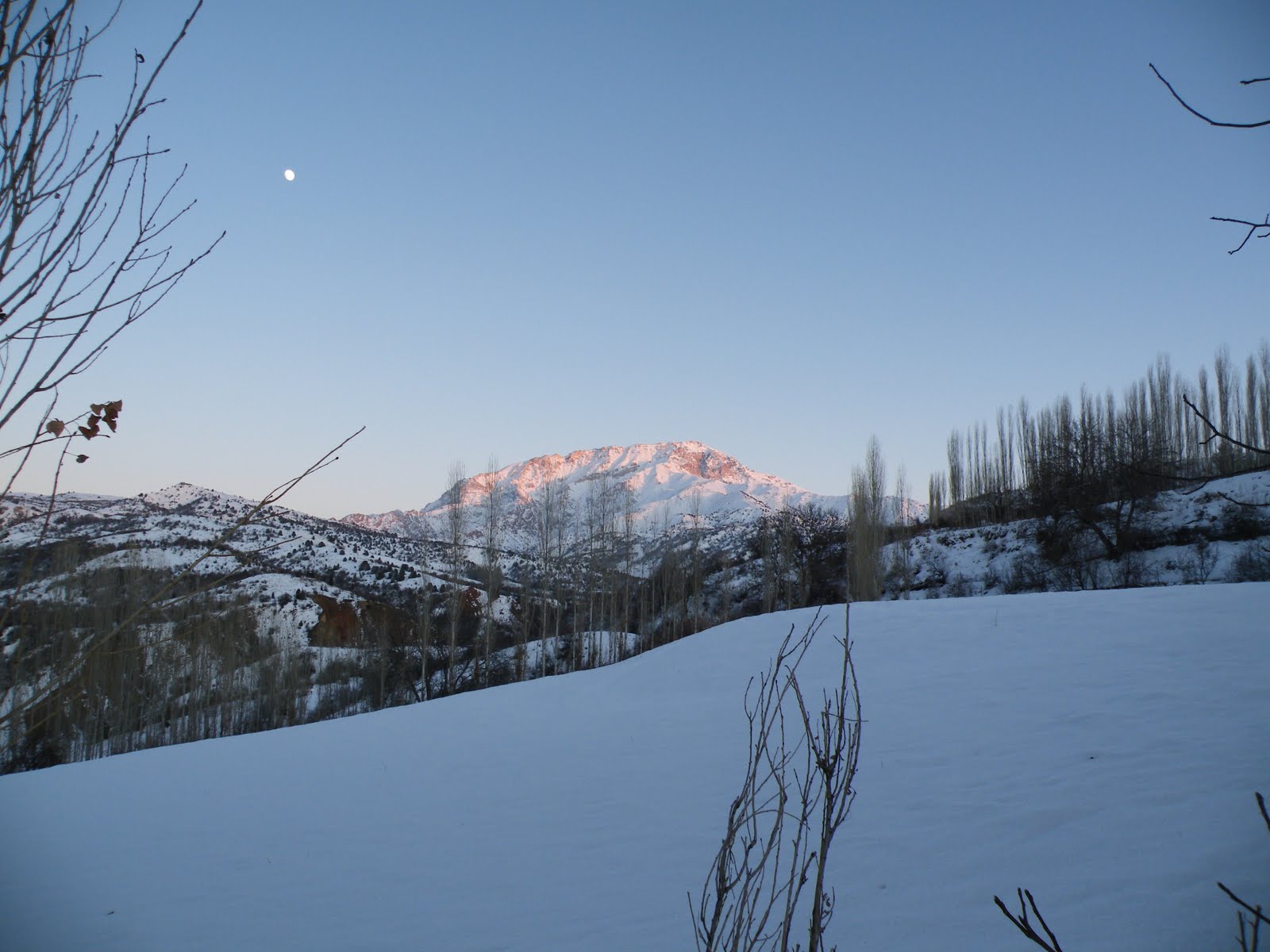
The mountains outside Tashkent really are beautiful – not as vast or evocative as the Tien Shan and Pamir ranges in nearby Kyrgyzstan and Tajikistan, but to someone like me coming from such a terminally flat land as England, they are entirely satisfactory for my needs in that they are agreeably pointy and have snow on top, as everyone knows all proper mountains should. The foothills where we were hiking were green and gorgeous, and full of things which were about to turn into wild tulips (although apparently you have precious little chance of actually seeing said tulips, as locals harvest them as soon as they bloom and sell them in the towns). Still, there was a nice line in blossoming fruit trees, scenic donkeys and pretty (if somewhat brown) waterfalls, and our group (which was quite an odd bunch – the hiking club was set up by German diplomats, so the party contained two ambassadors, and of the rest only I and a few Austrian tourists had no connection to any embassy) was gregarious and not too speedy, so I’m looking forward to tomorrow. With any luck we might be able to find ourselves at least one tulip.

From the sublime to the ridiculous (or possibly vice versa), I feel that I can’t leave it any longer before waxing lyrical about the joys of the Tashkent metro. This, and not the TV tower, is the real highlight of Tashkent, but sadly photos are very much forbidden (enforced by the slightly disconcerting number of police hanging around in every train and station) and for some reason no one seems to have thought that postcards of the public transport system might sell. I love it all, from its severely square blue trains with fake-leather seats which I am suspicious may actually be made out of cardboard to the clocks at each station which count down the time since the last train left, and don’t go above 9.59, but just stay frozen, refusing to admit to the possibility that such a well-regulated mass transit system could result in trains running more than ten minutes apart. Each ride costs 400 sum (about 20p) for which you obtain a blue plastic token which you solemnly insert in a ticket barrier with no actual gates, and descend down flights upon flights of polished marble stairs (which, as I have mentioned, are more likely than not to have been recently washed and thus thoroughly lethal unless you pay close attention), through huge metal blast gates (the stations were originally built to double as nuclear shelters, and the gates are clearly occasionally used, leaving you not entirely sure if you’re ever going to make it back out again) and onto the vast platform, inevitably about 15 or 20 m longer than it needs to be and with one, solitary bench, usually monopolized by somebody’s shopping.

This is OK though, because it gives you a chance to wander around and gawk at the décor which varies hugely in scale, lavishness and taste and comprehensively puts every single tube station entirely in the shade. My local is Kosmonavtlar, a gloomy, navy-blue temple to the heroes of the skies decorated with what was doubtless in 1978 super-futuristic crazy glasswork on the columns, and huge circular portraits of the Soviet cosmonauts plus, in a nod to a local celebrity, Ulug Bek, an astronomer grandson of Timur who ruled parts of Uzbekistan in the fifteenth century. Others stations sport scenes from the works of the authors they are commemorating (the Tashkent metro has a decidedly literary bent), or in case of failure of imagination, just compete to outdo each other in the sheer weirdness and extravagance of their lighting units. Until I learned their names, I distinguished the stops on the way to work by their different designs of chandelier. The trains themselves are somewhat rickety (although no more so than the best the Northern line has to offer) but never (touch wood touch wood) appear to break down or mysteriously pause for half an hour while “waiting for a vacant platform” or similar. My one criticism would be the unnecessary preponderance of exits that most stations have - interchange stations have two names and at least eight exits; consequently, a considerable proportion of my free time is spent waiting for people at the wrong metro entrance, but even this means that the odd miraculous occasion on which we both end up at the correct spot becomes that much more special. In short, I feel that London transport is wasting its time upgrading the track and refurbishing platforms to make the tubes run faster – clearly all a metro system needs to make it work is a generous sprinkling of chandeliers.


…and the fact that I’ve just written this much about the metro probably means I should get out more, so I’m going outside to make the most of the break in the weather and not think about transportation or phrasal verbs at all.