Wednesday, March 24, 2010

India pretty


I confess to still longing for Iranian flash and glitter, but Mughal architecture isn't bad either.

Wednesday, March 17, 2010

In which I am briefly an international superspy

I am writing this from Delhi, which is not at all where I was expecting to be a few hours ago. I must say that India is rather a startling place to have thrust upon one unexpectedly.

It is the week leading up to No Ruz, the Iranian new year, and I had been rather hoping to spend this week peacefully jumping over bonfires (it's a thing), admiring Achaemenid ruins and having earnest young men recite Persian poetry at me (an occupational hazard all over Iran, but utterly delightful). I, sadly, had reckoned without the efforts of the Iranian security service.

These diligent gentlemen hauled me off the bus from the border, assuring me that they merely wished to ask me a few questions; the generalised hysteria which greeted my suggestion that they might show me some ID ("This police station is our ID!") suggested that they were not necessarily the concerned members of the tourist police that they claimed to be. Over the course of numerous lengthy interviews over the following few weeks, it became apparent that they were highly suspicious of my motives of entering the country, and had in fact been waiting for me ever since I applied for my visa in Tashkent. My gender, marital status, failure to utilise a travel agency and "impolite way of sitting" all told against me. I was quite obviously an MI6 agent.

Let this be a lesson that all may profit from: NEVER bring a computer or a camera into a country policed by paranoiacs with an active imagination. It's amazing what can be concocted from the most innocuous sources. Half-finished end-of-term reports on my English students became evidence that I was recruiting Uzbekistan's most talented linguists as secret agents. A document that I had been proofreading at UNAIDS indicated that I had been setting up high level meetings with members of the government. Photos of a party in Tashkent were clear proof that I had been fraternising with expat Iranians (never mind that said photos contained no Iranians whatsoever). I apparently spoke too many languages (that sound you hear is hysterical laughter from anyone who has ever been on the receiving end of my tortuous French or Russian. Actually, it was probably the Russian that swung it. It is an inherently suspicious language.) to be an innocent traveller. In the face of such brain-straining deductive logic and fiendishly penetrating questioning along the lines of "If you're so interested in travel, why didn't you study tourism?" , I found myself quite unequal to the task of proving myself a mere tourist ("you don't LOOK like a tourist..."), and thus received instructions yesterday morning to leave Iran within 24 hours, or face "certain incarceration", and while I like to think I am always open to new experiences, finding out exactly what the inside of an Iranian jail looks like ranks pretty low on my list of priorities. I took the next flight out of Iran.

Thus, I find myself in Delhi with no hotel, no plan, no clue; just a raging sense of unfairness (funny how we think life should be fair, when it never is). Later I will write properly about the incredible times I had in this wonderful country (well, the parts outside the police stations), which is so ill served by an illiberal and repressive government at odds with so many of its people. Iran is an easy country to fall in love with, and I feel like I have been cheated out of an affair that could have lasted and lasted. I probably won't be able to visit Iran again, at least while the current state of affairs continues, and what angers me most is that my experience, which I was so sure would prove the opposite, has instead just born out the warnings of my friends who told me I shouldn't risk the trip. I will never regret visiting Iran, but I wish it could've ended any other way.

Well, there's no point wallowing in self pity at this stage. I have a subcontinent to deal with.

Friday, February 19, 2010

Xayr O'zbekiston, yakshi qo'ling


Tomorrow morning I'm leaving on what I hope will be a six month trip through Turkmenistan, Iran, Pakistan, China, Kazakhstan, Kyrgyzstan, Tajikistan and back to Uzbekistan. Getting the visas was such a performance that it became an end in itself, and now I have a passport full of stickers it's begnning to sink in that oh crap, I'm leaving tomorrow. Now the thought is almost overwhelming: I have Persepolis and Isfahan and Kashgar and the Hindu Kush all before of me, and I am so excited and terrified that I can hardly breathe.

I've no idea what it's going to be like; I've never travelled alone for such a long period before, and although I'm reasonably confident of my ability to handle most things these places may throw at me, I'm a little worried I may find it all too mentally exhausting and crash after a month or two. Except this is what I've been dreaming of for years, and I've lived on my own for a year in one of the most frustrating and ridiculous countries in the world (I love you, Uzbekistan, but good Lord, you don't make it easy), and I've just spent a week in Afghanistan (this did seem like a sensible idea at the time), and now is not the time to wuss out. I can do this.

It is, however, a great shame that the buildup to epic journeys has to be ruined by bloody packing. Marco Polo was strangely silent on this point (mind you, things would be a lot easier if I had my own caravan of camels). My backpack capacity seems to decrease every time I use it.

Friday, February 5, 2010

Premier league buzkashi


I am (still) recovering from a new year spent in Bukhara, primarily being fed. New year is the most important winter festival here, and, like all good festivals, involves family and food in large quantities. Just when you’ve finished three courses and are eyeing the fruit bowl and contemplating whether there is in fact a polite and non-messy way to eat a pomegranate, out comes the fourth, and then you sort of want to die. In an attempt to prevent myself from sinking into a mutton-and-oil-induced stupor (a recognised medical condition in Central Asia), I’ve been spending the weekends stomping around the mountains (Tashkent has had a disappointingly mild winter, with only a couple of desultory snowfalls, but the weather in the mountains certainly make up for it). Given that flailing around in waist-deep snow loses its novelty after a while, I jumped at the chance to spend a day with some friends at a village which was hosting a championship of that most Central Asian of games, known variously as ulaq, kukmar, kupkari and kuk-boru. Never heard of it? Yes, you have. You know, the one with the dead goat? Yeah, that one.

The Tajik name (buzkashi) translates, more or less, as “grab the goat”, which pretty much sums the whole thing up. A goat is slaughtered and the head removed; the carcass is then soaked in cold water overnight to toughen it. The next day, several dozen horsemen assemble and fight over it. I think there’s a method for goal scoring in there somewhere, but lets face it, that’s not especially important when you are engaged in serious horseback wrestling. Enjoyed primarily by the historically nomadic Kyrgyz, Kazakh and Tajik people (indeed, Kyrgyz evening TV schedules give pride of place to a buzkashi Match of the Day, complete with interviews inarticulate players, grumpy managers and overly groomed commentators), my announcement that I was going to a game was met by blank looks by my Uzbek colleagues, who eventually admitted that this might be something that “those weird people in the mountains do”. Indeed, the playing field was a plateau set in a mountainside outside a village miles from anywhere, almost on the Tajik border. We were deposited by our rickety-lada-driving taxiste on an icy footpath, and immediately had to fling ourselves out the way of a hundred or so horsemen hurtling past on a detour from the field of play. Rule one of buzkashi seems to be that the game is wherever the goat is.

The spectators had ranged themselves across the hillside among dozens of makeshift barbeques and snowdrifts sprouting cooling vodka bottles. The horsemen (and yes, they were all men) ranging in age from six to sixty (and the rule was not necessarily one man, one horse) hurtled around the field below, caked in mud and slush. Every so often, the guy with the goat would decide that playing on the field was cramping his style and make a beeline directly up the hill towards the onlookers, forcing everyone to make a run for it, scattering fur caps, empty vodka bottles and spare goats in all directions. Over the chaos, the commentators, aided by a monumental sound system the looked as though it had been patched together from several dozen car radios, kept up a breathless, multilingual commentary. As a group containing the only two women in attendance, our presence attracted a certain amount of excitement and we were immediately invited to introduce ourselves on the sound system and tell everyone how much we loved Uzbekistan (a lot, obviously) and drink a toast to international friendship.

The four of us wandered around taking photos and dodging stray horses, offers of dinner and marriage, and people who were keen to show us their photo album of their horses which they had named after Premier League football teams. The game (or games - someone assured me that several teams came and went, but I really couldn’t tell the difference) went on all afternoon, and as the sun went in it became bitterly cold, prompting the spectator to up their fortification with copious quantities of vodka, plov, shashlik and vodka. Since none of us had really dressed for subzero temperatures, we were by this time all too happy to accept all of the above, and the proceedings rapidly became pretty merry. Eventually, a team (or person? I really never got the hand of the rules) and they (or he?) were awarded an extremely irate-looking eagle as their prize and everyone stumbled back down the hill, carrying the prone bodies of their friends who had medicated against the cold too liberally or received a knock on the head from an over-enthusiastic goat-chaser, only stopping for one final vodka-fuelled picnic in the snow at the bottom of the valley. By this time we were firm friends with Premier League Horse Guy, so we retreated to his brother’s house to defrost and drink toasts to love and international friendship and horses named Arsenal and so on. I have no memory of how we got back from the mountains, but those who were alive to the particulars of our chauffeur’s driving on the icy roads assure me that this is a good thing. Sometimes one is happier not knowing.

Anyway, drunk driving aside it was something I was glad to have experienced, because my time in Uzbekistan is rapidly drawing to a close. In a couple of weeks I'll be heading to Turkmenistan (fingers crossed for the most awkward visa in Central Asia) and Iran (headscarf-tying practice in progress), so every day at the moment is an exhausting mixture of hanging around in embassies perusing prmotional leaflets exhorting me to consider the investment opportunities inherent in the Pakistani towel industry and visiting every nook and cranny of Tashkent I could never be bothered to before (Hello, museum of cotton-picking, can't think how I missed you!). And for those of you who asked, pictures (including buzkashi) are (finally) here.

Sunday, December 27, 2009

Christmas hike


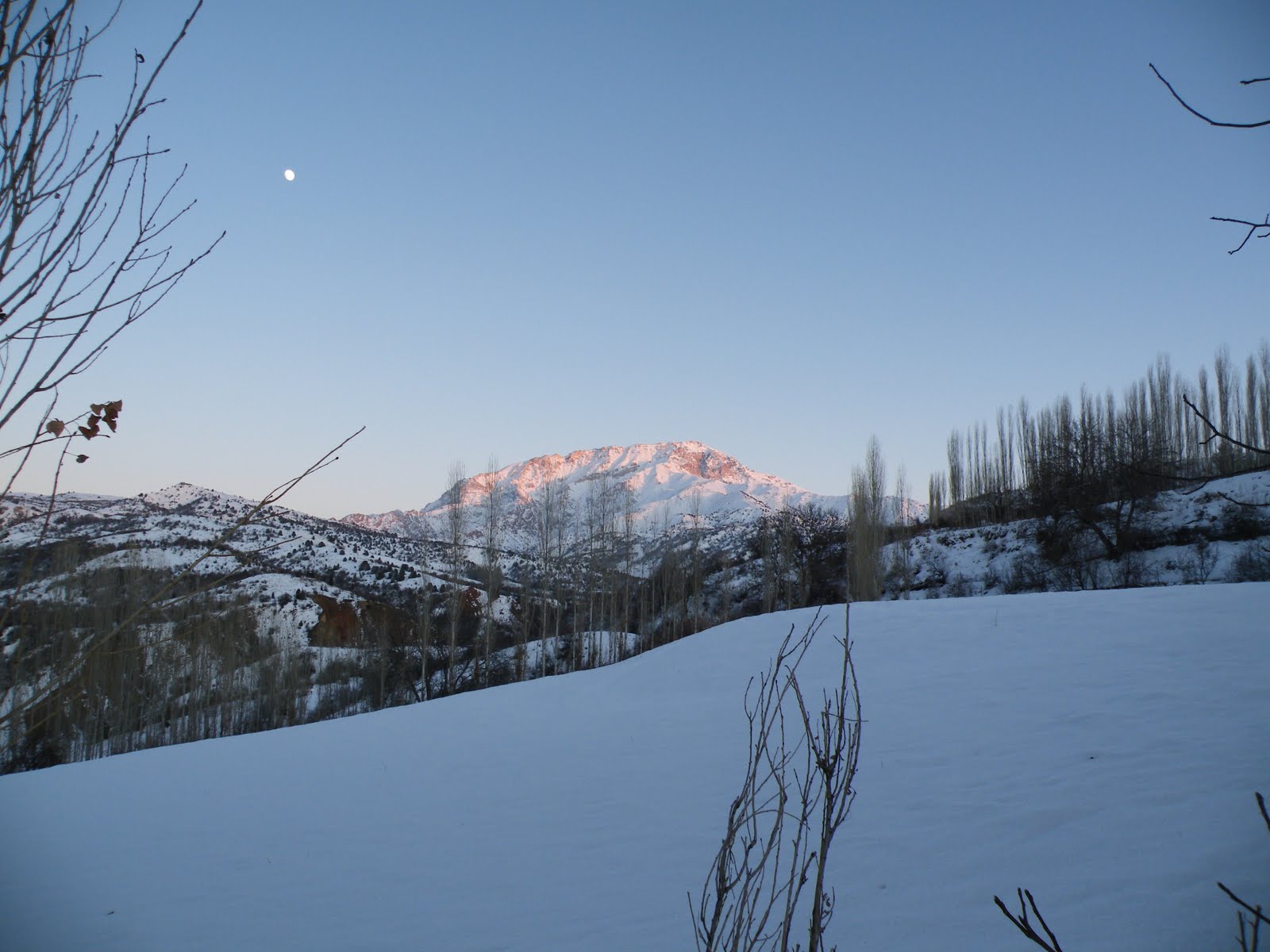
We have not had much in the way of snow in Tashkent this winter. The mountains around us have had quite a lot. Nothing, however, deters our hiking guide, the indomitable Boris (on the left, wearing the bright pink fleece. He pulls it off.), and we wade over the hills of a Sunday afternoon with great intrepidity. The Boxing Day Brisk Walk (TM my mother) is the one Christmas tradition I've managed to hang on to here, so I owe Boris for that.

Sunday, November 29, 2009

Thursday, September 10, 2009

Kyrgyz hospitality unleashed in all its muttony glory


Since Tashkent was persistently failing to honour the "get colder" part of autumn, I fled, as soon as I was decently able to Kyrgyzstan, about which I knew little but that it was high, and therefore cold, and that it had to be better than dusty Tashkent with its sputtering fountains and artificially green flowerbeds that serve only to emphasise the dryness of the air. I believe it was at the point at which I was stuck in the middle of a blizzard on the ascent to a 4000m pass, clinging frantically to my horse as it floundered through snow up to its chest that the thought occurred that perhaps there were less uncomfortable ways to escape. Surrounded on all sides by the massive peaks of the Tien Shan range, I felt that such a setting deserved slightly better than my flailing. One hundred and fifty years ago, British and Russian spies disguised unconvincingly as Turkmen horse traders were sneaking through these mountains, vigorously intriguing against each other all the while, and now here I was, trying not to fall off my horse and feeling utterly incapable of even the smallest intrigue. I couldn’t help feeling that I was lowering the tone of the landscape somewhat.

Kyrgyzstan is all about the majestic landscape: over 90% of the country is at an altitude above 1500m and nearly 50% is over 2500m. Lacking the picturesque crumbling masonry possessed in such abundant quantities by Uzbekistan, the country sells itself on a combination of its spectacular scenery and the traditional hospitality of its people. For centuries the Kyrgyz lived an entirely nomadic lifestyle, tribes pitching their yurts together and moving on every few months or so. The Soviets more or less put an end to this, but since independence many rural families have resumed a semi-nomadic existence. Come May or so, the yurt is loaded onto the top of the Lada, and everyone heads with their livestock to the jailoos, the beautiful and fertile alpine pastures that sustain the sheep and cows which are the livelihoods of these people. By the end of September, everyone heads back down again, but for those few months yurts cluster like mushrooms across the hills and mountains, by lakes, up tiny valleys, anywhere there is water and good grazing. Many families have decided that tourists seeking an Authentic Nomadic Experience are a better bet than sheep, so once you leave the unlovely cement streets of Bishkek, the capital, you are swept up into the hills and into a yurt with almost indecent haste. Fortunately, we are all here for the yurts, and from my viewpoint in a yurt by a mountain lake that would have been no doubt absolutely lovely but for the rather Welsh weather, I too was able to observe “Kyrgyz hospitality unleashed in all its muttony glory!” as one of the more enthusiastic local brochures put it.

Said hospitality is genuine, effusive, and generally involves much discussion of everyone’s marriage and children (potential children will do if you are lacking in this department, but this is considered letting the side down) conducted over copious quantities of food and drink, among which the prime culprit is the dread beverage kumis. Kumis is fermented mares milk and tastes exactly as awful as it sounds. It is mildly alcoholic, with a smoky, beery, rancid taste and an effect on the unwary digestive system that can only be described as unfortunate. It is the drink of welcome in a yurt, and one cannot stop anywhere without being presented with a large bowl of the stuff, which you have to at least attempt out of politeness, although finishing it is a risky business as it will immediately be refilled. I developed a kind of love-hate relationship with the stuff, and became unable to stop myself from sampling it at every opportunity, because I could never believe it was quite as horrible as I remembered (it always was). Much better is the Kyrgyz cream tea - fresh bread (cooked in a large saucepan on top of a stove, a technique which I never managed to get my head around), fresh cream and home-made jam. Oh, and tea. Pots and pots and pots of tea (I counted an average of about eight bowls per meal, which translated to about five or six mugs). When your water source is the stream you share with your herds of cows and horses, it is undeniably a better idea to rehydrate with tea as opposed to unboiled water, but yurt tea is usually served with sugar, condensed milk or jam (occasionally all three) which can be a little overwhelming. The Kyrgyz phrase the visitor is most likely to leave with is the stern “choy ich!” - drink tea! - that greets any protestation that one has had enough to drink. This is before even one gets to the muttony part (the primary ingredient of all Central Asian cuisine is mutton fat, and it remains a mystery to me how everyone here doesn’t die of heart disease before they’re thirty), and the upshot is that if you are me you end up huddling under a pile of blankets clutching your stomach, wishing you didn’t feel quite so full and vowing never to have any children.

After a few days of muttony hospitality, I was left feeling in dire need of a more active way to appreciate the scenery. Parked as I was in a lakeside yurt camp, I was thinking vaguely along the lines of a one day amble on horseback along the shore; however, by a combination of circumstances, the exact details of which escape me but I’m pretty sure involved a bottle of vodka, I found myself together with a charming British couple accompanying the guides and packhorses of an organised hiking tour (now disorganised and soaking their feet in the lake) 150 miles back home over the mountains. The vodka had naturally put paid to any qualms about our collective lack of horse riding experience and Russian language skills the previous night, but in the cold light of day the mountains looked steep, the horses were clearly unimpressed, and the guide had clearly taken my cautious venture that I speak “chut-chut pa-Russki” as admission of complete fluency. We struggled up that first ridge gasping fish-like in the thin air, with the guides more or less having to drag our horses who had not signed up for riders on the return leg of their journey, and were making their feelings clear. By the time we reached the top, I was more or less ready to call it a day and would’ve happily abandoned the horses to find their way back on their own, except that from the top you could see nothing but the lake stretching away towards one snow-capped mountain range after another, and nowhere could you see any habitation or sign of life apart from a herd of sheep clinging to a precipitous hillside, and it felt like we were the only people in the world. Which was actually a pretty good feeling, so we rode on.

For the next few days we rode along valleys, scrambling over ridges and up barren, stony morraine and across glaciers melting quickly in the late summer heat and unpleasantly prone to collapsing ice bridges, and over the steep, icy passes and back down again, galloping in slapdash formation across hillsides bright with wildflowers and air thick with bees and butterflies, and down, down, back to the treeline and then through pine-covered canyons until the valley broadened out into wide pastureland cut by a lazily meandering river, and a cluster of yurts sending trails of smoke into the chilly evening air. We stayed with farmers and eagle hunters (erm, they hunt with eagles, rather than hunting the eagles themselves. The golden eagles circling overhead in a picturesque manner gain a slightly more threatening air when you have spent a cheerful evening being shown a photo album full of pictures of the WOLVES which the eagles have killed ON THEIR OWN) in their yurts, nursing our blisters over tea, kumis and bowls of laghman (noodles in mutton soup). One night, I struggled out of the yurt at midnight (the combination of too much kumis, a cavalier approach towards the use of water purification tablets and the local remedy of five shots of vodka laced with pepper (NB I cannot emphasise enough how much this does not work, although it undeniably takes one’s mind off things) was proving a little much for me) and literally gasped aloud, because I didn’t know it was possible to see so many stars. There was no hint of an electric light for miles, but the stars were bright enough to cast shadows, highlighting the silhouettes of the mountain peaks surrounding me. In the morning there was frost on the ground in the shadows of the yurts and the cows loomed out of the mist like ghosts as the sunrise turned the mountaintops pink, and I thought that I had never been anywhere so beautiful in my life.

Just writing that is making me feel less than happy that I am in grimy Tashkent again, and the view out of my window is of grubby apartment blocks rather than rolling mountains. The school I wwas working at has been closed, so I am somewhat at a loose end at the moment, and Tashkent is more or less entirely the wrong place to be at a loose end in. Since the only other option seems to be joining the cotton harvest (the cotton picking season is beginning, where the universities shut for a month or two and the students are sent out into the cotton fields to bring the harvest in) and this sounds rather like hard work, I am dashing off to see the rest of the country to put off making a decision about what to do next. Procrastination forever!