Words and phrases in Russian that I now know and wish I didn't: civil war, ethnic conflict, murder, rape, genocide. The appalling violence between ethnic Uzbek and Kyrgyz that exploded in the south of Kyrgyzstan last week is the only thing that anyone here is talking about (warning: both articles contain graphic descriptions of violence, and I found the latter in particular very difficult to read).
From here's it's pretty difficult to tell exactly who or what lies behind the eruption of violence: the interim government (and many locals I've spoken to) are quick to blame provocateurs in the pay of former president Bakiyev, ousted in April (and it certainly seems that a lot of the violence was organised in advance) and it also appears that the security forces may have been complicit in the attacks. No one here in the northeast seems to harbour any particularly strong ant-Uzbek sentiments or blame the Uzbeks for the attacks, but then there are hardly any Uzbeks in this part of the country. I rather suspect that opinions are very different further south.
I'm in Karakol, in the northeast of the country, which so far has remained peaceful and thankfully looks like it will remain so. Most of Kyrgyzstan's international borders are closed at the moment, so I'm here for at least the next couple of weeks (which actually suits me down to the ground, as rural Kyrgyzstan is as wild and beautiful and hospitable as ever) but keeping a close eye on developments (given the tight visa regimes in all the surrounding countries, short of flying back home there is rather a shortage of quick and easy escape routes even if the borders do reopen, so that should prove interesting). Watching this play out is miserable: this country is easily one of my favourite places in the world, and just a few months ago seemed to have so much going for it; although now the threat of civil war seems to have receded a little, to see things disintegrate like this is just heartbreaking.
Friday, June 18, 2010

Sunday, June 6, 2010
Turkistan

 The mausoleum of Kozha Akhmed Yasui in Turkistan is Kazakhstan's sole entry in Central Asia's Blue Dome Hall of Fame (currently dominated by Uzbek specimens), but a good effort, I think. I like the rose garden.
Friday, June 4, 2010
Adventures in public transport #2: across Kazakhstan by train
In Europe and America people in a train travel in a train fully aware that it belongs either to a state or company and that their ticket grants them only temporary occupation and certain restricted rights. In Russia people just take them over.-- Laurens van der Post, Journey into Russia
 The problem with Kazakhstan is that it is a sodding big country. It is approximately the size of Western Europe, except with a population of only about fifteen million and not an awful lot going on apart from a lot of steppe. Aktau on the Caspian is, according to my Beacon of Progress map, at least 1000 km from the nearest town of interest, and my own particular interest lay with the Kyrgyz consulate in Almaty, over 2000km away on the other side of the country (3000 km travelling distance. The placement of transport links here is somewhat eccentric.). Since internal flights are not exactly cheap and buses non-existent, I was obliged to grit my teeth for the four-day-three-night marathon train journey.
Ex-Soviet trains aren't awful - OK, so they're not the Orient Express, but the compartments are clean (even the toilets aren't too hideous) and the bunks are comfortable and there are samovars of hot water in every carriage so the tea supply remains constant - but not anywhere I'd choose to be stuck for four days in a row. Particularly when I haven't showered for the previous two (the Aktau customs-house was good, but not that good). Plus, the scenery for the first three days was not especially stimulating. Having spent much of the past year or so visiting cities whose illustrious histories tended to end with "and then Jenghiz Khan came and burnt it to the ground", I had been given in my more idle moments to speculate vaguely about what drove a person to such extremes of destruction, but no longer. After a mere eight hours of brown, scrubby steppe I was ready to set something on fire just for variety's sake.
However, my mood was improved immeasurably when I succeeded in wheedling two kettles of hot water out of a woman at the station at Aqtobe (1000 km from Aktau in the wrong direction - seriously, what is up with the trainlines here?) where we stopped to change trains, and I can now confirm that it is both possible and exquisite to wash in 3 litres of water when the need arises; and more so when I returned to the train to find that my compartment now contained a Kazakh matriarch who immediately produced a large bag of bread and cakes and pronounced it time to drink tea. Train travel here is a ridiculously sociable affair, and though most passengers were younger guys returning home from work on the western oil and gas fields, and thus not necessarily the best choice of conversational partner (unfortunately experience has indicated that it is for the best if my Russian skills vanish entirely when faced with any unaccompanied guy between the ages of about fifteen and fifty - when the opening conversational gambit is "Soooo, do you have a boyfriend?" you know it's only going to go downhill from there), there was a family or two and seeking out the women rarely goes wrong. I commiserated with girls my age about how tiresome it was to have to find a husband when you're also trying to get your phD, admired various small children, was firmly advised against my planned travels to Kyrgyzstan ("Don't you know they're having a revolution there? Anyway, you should stay in Almaty. It is civilised. Not like Asia.") by everyone, and drunk tea and kefir (fresh drinking yoghurt, absolutely heavenly) by the bowlful. Every hour or two the train would idle to a halt at a tiny settlement with no name on the platform (I have no clue how anyone else knew where we were, I only occasionally saw a sign), just dozens of women selling iced water and instant noodles and fried fish in plastic bags and meat dumplings of dubious freshness, so although there was a restaurant on the train, no one bothered with it. As a foreign guest I was urged to eat more and more, and people kept stopping by with ice creams and blini and fish and mutton and potatoes and plov, none of which could be refused. It's probably a good thing the journey didn't last much longer, or I probably would've exploded.
73 hours later the train pulled into Almaty, and I was immediately whisked off to the house of a couple I'd met on the train, to be fed even more and oh bliss, they had a sauna too which I practically had to be dragged out of. I can confirm two things: that Almaty is indeed very civilised, and that I am never doing five nights on public transport ever again.
Adventures in public transport #1: the Caspian ferry

Waiting for the Kazakhstan ferry proved a depressingly Beckettian state of affairs. My companion in this endeavour was Juergen, a German backpacker who'd missed the previous ferry by twenty minutes, having waited a week for it beforehand and was thus understandably losing his sense of humour slightly. After a week, the only news that we had received was from a rather wild-eyed Filippino tourist who'd just taken the ferry from Turkmenistan and whose English wasn't great, but the phrase (accompanied by a lot of emphatic gesticulating) "it's hell" came across pretty clearly; we had just begun to reluctantly investigate flying, when I got a phone call from the tourist office. "The ferry is leaving in an hour. I think maybe you should go now!". Right.
Frantically dashing to the port, we were cheerfully informed that yes, a ferry was going to Kazakhstan, and we could even buy tickets, but of course it wasn't leaving at once, and in fact, no-one knew when it was going to leave, so we'd better sit down and wait until something happened. This frequently takes a while in Azerbaijan, and so it proved. Six hours later, we were all aboard the Akademik Zafira Aliyeva, a surprisingly (to me) shiny and modern boat (I only saw one cockroach in the cabin) carrying goods wagons and Turkish trucks and a mere eleven passengers (the tendency of the shipping companies in previous years to overload the ferries with passengers and the accompanying tendency of said ferries to sink had apparently prompted authorities to be pretty strict on this point) across the Caspian to Kazakhstan.
J and I had stocked up on bread and tea, expecting to ride out the eighteen-hour crossing in limited comfort and space, but this is apparently the wrong attitude to approach boat travel in this part of the world. One of our fellow passengers was a Georgian, which of course meant that within seconds a whole cold chicken, a bag of khachapuri , a (literal) gallon of wine and two bottles of chacha (the Georgian national drink, a home-brewed firewater of a potency so lethal that it should probably be banned under international treaty, and that any self-respecting Georgian male keeps at least a flask of on his person at all times in case of a toasting emergency) made their appearance. The evening predictably degenerated into round after round of heartfelt and tearful toasts to the friendship between all nations (except Armenia - it is generally not a good idea to get Azerbaijanis started on this particular topic) and the brotherhood of all men (except Armenians), one of the most enthusiastic participants in which turned out to be our chief navigator, which seemed to me to be a bit of an error given that we hadn't even left Baku at this point. Indeed, everyone having boarded around 7.30 pm, the ferry only began to move at midnight, around about the time at which England and Germany were being declared honorary members of the Caucasus.
I woke up the next afternoon, rather wishing that I hadn't (chacha frequently has this effect), but in time to get the full effect of the sun setting across the Caspian. This also meant that we were several hours behind schedule (evidently the navigator was feeling the effects of the previous night as much as the rest of us) but punctuality is an overrated trait, at least when there's plenty of tea to be had. We drew into Aktau at midnight, only six hours behind schedule to the tinny strains of the Kazakh national anthem played through the port loudspeaker system. Signs that I had entered Central Asia proper abounded: the increasingly ludicrous size of the peaked caps worn by various members of officialdom (the customs officers' looked as though they had some sombrero in their ancestry), the return of tricky geopolitical debate at immigration ("You are Irish?" "No, English." "But your passport says Ireland." "No, it says 'United Kingdom of Great Britain and Northern Ireland'. Great Britain. Velikobritannia?" "That is Ireland!" "No." and so on, ad infinitum) and, as we picnicked at 2.30 am in the customs house, the presence of large women ladelling generous spoonfuls of homemade jam into our cups of tea. It's good to be back in 'stan central again.
 Tea with rosehip jam drunk out of a saucepan lid at 3 am in the Aktau port customs-house. Yep, definitely back in Central Asia.
Wednesday, May 26, 2010
Mud volcanoes go here

They go "blop" a lot, and are fun to stick your fingers in. I'll leave it to you to imagine how muddy I got today.
Tuesday, May 25, 2010
Midwinter city breaks in all the wrong places

So this episode takes place back in February, when I was tangled up in the forest of red tape and consular interviews and demands for parental and spousal permission that accompanies any attempt to gain travel documents for Central Asian countries. In this bureaucracy-befuddled state, a minibreak sounded just the ticket, and location-wise the fact that you could get the relevant travel documents in a couple of hours with no questions asked was all a country needed to recommend itself to me. Uzbekistan has only one neighbour which is so enthusiastic about handing out visas, and so it was that within a couple of days of hatching this brilliant plan I found myself eyeing the Uzbek-Afghan border post with a vague sense of apprehension and wishing that I would think my decisions through a bit more thoroughly sometimes.
The border is delineated by the murky brown Amu Darya, still imposing this far east before fading into irrigation-drained ignominy before ever reaching the Aral Sea. When it was still the Oxus, Alexander the Great floated his armies across the river here on hide rafts in order to ravage the eastern satrapies of the Persian empire; now the two countries are linked by the Soviet “Friendship Bridge” (all the better to invade you with, my dear). It’s a remarkably sharp dividing line - I’ve never crossed a border where the contrast of the two sides has been so absolute. On the Afghan side, there was an atmosphere of barely-suppressed chaos quite unlike the ordered blandness of Uzbek Termez. The traffic was heavy with exuberantly decorated lorries redolent of the subcontinent, auto rickshaws and dignified old men on donkeys, everyone wrapped in shawls and blankets to keep out the freezing wind. I was painfully aware of the fact that I was the only woman on the street, and felt increasingly uncomfortable as I waited for my ride - not so much unsafe, as keenly aware that here far more than anywhere else in the world, anything could happen and quite probably would.
On the drive through barren, windswept and snow-sprinkled desert to Mazar-i-Sharif, we passed convoys of the international troops stationed nearby: Swedes, Croatians, Germans, and, of course, Americans, rolling slowly past in their humvees, holding up the traffic for miles behind them - they are said to be under orders to shoot at any car that comes too close, so everyone keeps a careful distance. Although Mazar and its immediate environs are considered “safe” by Afghan standards, an awareness of the war penetrates everything and there is a tension in the air that is palpable (although how much of it was I imagining, because I knew?). Mazar itself is an odd, mixed up city with expensive new glass buildings (“mafia money”, muttered my host darkly) standing side by side with mud houses along unpaved, heavily rutted and rubbish-strewn roads, while the immense mountains of the Hindu Kush rising to the south. Electricity is intermittent, so the city reverberates at night to the rumble of hundreds of private generators. Sometimes I could believe I was in any Central Asian city, as I was pursued by carpet salesmen, moneychangers and taxi drivers , but then I'd turn a corner and see a tank easing its way ominously down a side street. I couldn’t stop staring at the tanks whenever I saw them, they seemed so unreal, as though I’d stumbled onto a film set by mistake. I don’t think I’d even seen a tank outside of a museum before, and didn’t that slam home to me just how unbelievably I am to have been born somewhere where that's the case. Mazar may be peaceful, but it doesn't stay that way spontaneously.
The heart of the city, and the only ancient building of note is the Blue Mosque and shrine of Hazrat Ali, the burial place of the Prophet’s son-in-law, and another hugely important site of pilgrimage for Muslims. I’d seen a photo of this building at an impressionable age, and had been determined to see it for a long, long time. Although much smaller and arguably less impressive than the Haram in Mashhad, it makes a better impression because it isn't cut off from the secular city like the other place, and it's easier to take it all in at once. Rather than glittering gold, every inch is covered with the bright blue of lapiz lazuli, the colour always synonymous in my mind with Afghanistan. The weak wintery light didn’t do it many favours, and it's decorated at night night with unevenly hung strings of flashing lights that unfortunately bring to mind the Christmas decorations at my local shopping mall back home, which is not a good thing, but at dusk it becomes special. Non-Muslims aren’t allowed inside, and unlike in Mashhad, no one suggested I try, so I circled the walls and again, watching women in blue and white burqas feed the flock of pure white doves (every seventh dove contains the soul of a saint, and the overall effect is so holy that should a grey dove join the throng, it will turn white within forty days) and men in jeans and leather jackets loiter drinking tea in defiance of the snow.
For, with my usual impeccable sense of timing, I had arrived at what turned out to be the coldest week of the year, as a sudden freezing snap enveloped the whole region. Dozens of people were killed in avalanches on the main road south to Kabul, all the water pipes froze (except those in the public baths, and now I know it only takes three days without a shower to overcome my terribly British reticence regarding com`munal bathing) and the 80 km stretch of (good) road between Mazar and the border became so dangerously icy that I had to prolong my stay for several days. I spent a considerable amount of time huddling around coal stoves in unventilated rooms trying to remember if this was how people died of carbon monoxide poisoning, while my friends reminisced about how lovely the region was come about April or so. One of my hosts was a DJ at a multilingual Mazar radio station, and decided to take full advantage of this opportunity to inject some English into his programmes, and thus my discovery that there is nothing so terrifying, in Afghanistan or elsewhere, than a live microphone that someone expects you to talk into. My international broadcasting career began with a slightly uncertain introduction to the Black Eyed Peas, and hearing my voice coming out of the car radio while creeping along beind a convoy of tanks was one of the odder moments of my life.
We were on the way to Balkh, a small market town about half an hour from Mazar with a lot of stray dogs and rubbish in the streets and two thousand year old city walls and not a lot to distinguish the fact that it was once Bactria, the mother of cities and a pearl of the Silk Road. Ravaged by earthquakes, droughts, Jenghiz Khan and other occupational hazards of Central Asia, there is now barely anything to remind one of its glory days as the place where Zoroaster was born and the Alexander the Great was married and more trade passed through the markets here than through Samarkand and Bukhara combined. The remains of a mosque and mausoleum crumble in the filthy central square, and I suddenly thought about what London might look like in 200 years, which was not a very pleasant thought so I stopped thinking it. But a little way out of the city lie the ruins of the oldest mosque in the country, over thousand years of decay but still standing, with the faintest traces of lapiz lazuli in niches covering every column, which were once studded with the gemstones. UNESCO had covered the whole thing with an awful corrugated iron roof and there was no one there but the caretaker's cat and chickens (who got on surprisingly well) but it was still living; people still come on Fridays to pray there. Later, back in Mazar and politely trying to convince the local carpet salesmen that I really did not need a carpetal representation of Amir Timur (and let me just take a moment to say that no one, be they Ayatollah Khomeini or your pet Labrador, is improved by putting them in a carpet, and it is a mistake to try), I was offered silver Bactrian coins dug up from the fields around Balkh (I wish I could say it was my ethical stance against the looting of cultural heritage rather than a lack of cash that made me demur, but that would be very, very untrue). Bactria was still there, still not quite dead, and I thrilled at it.
Except that getting starry-eyed over romanticised versions of the past when the present is so imperfect and the future is so uncertain is troublesome here more than anywhere. At dinner with a family I’d met at the shrine, we sat around an oil lantern eating pilau, admiring babies and discussing wedding plans and politics. The presence of the coalition troops inspired no great ire in anyone I spoke to: "Only backward people hate the Americans. Everyone else just wants to work for them" (although it's worth noting that I was also told that "only backward people wear burqas". In a week I saw precisely one woman apart from me who wasn't wearing a burqa.) Yet there is clearly discontent: the day before I arrived, a Taliban member of the Afghan police force had killed two Swedish soldiers and their just outside the city. The local lad had been engaged, and working with the troops to save money for his marriage later that month. This story was the main topic of discussion for that week, but spoken about with resignation, in the knowledge it would soon be superceded by another tiny tragedy, even here, in the safest part of the country. Still, the consensus seems to be that things are slowly, slowly getting better. And yet, I couldn't help feeling that the presence of the coalition troops here was daft. This is not really the place for a discussion of the rights and wrongs of the invasion, but Afghanistan felt so much more foreign to me than anywhere else I'd ever visited, so self-contained and self-involved that the very idea that any Western power could successfully impose by force a an alien form of government on this country s ludicrous and the very height of hubris. I suppose it remains to be seen. The troops don't seem to be going anywhere for the moment, and they keep some kind of order in Mazar, but I can't see where it is going to end.
Back at the border, the Afghan official ran an uninterested eye over my passport, then invited me to share his lunch. Across the river I knew I could expect an hour's wait, a thorough interrogation and a search of every pocket and bag. I figured I could stay just a little longer.
Monday, May 24, 2010
Thalassa, thalassa
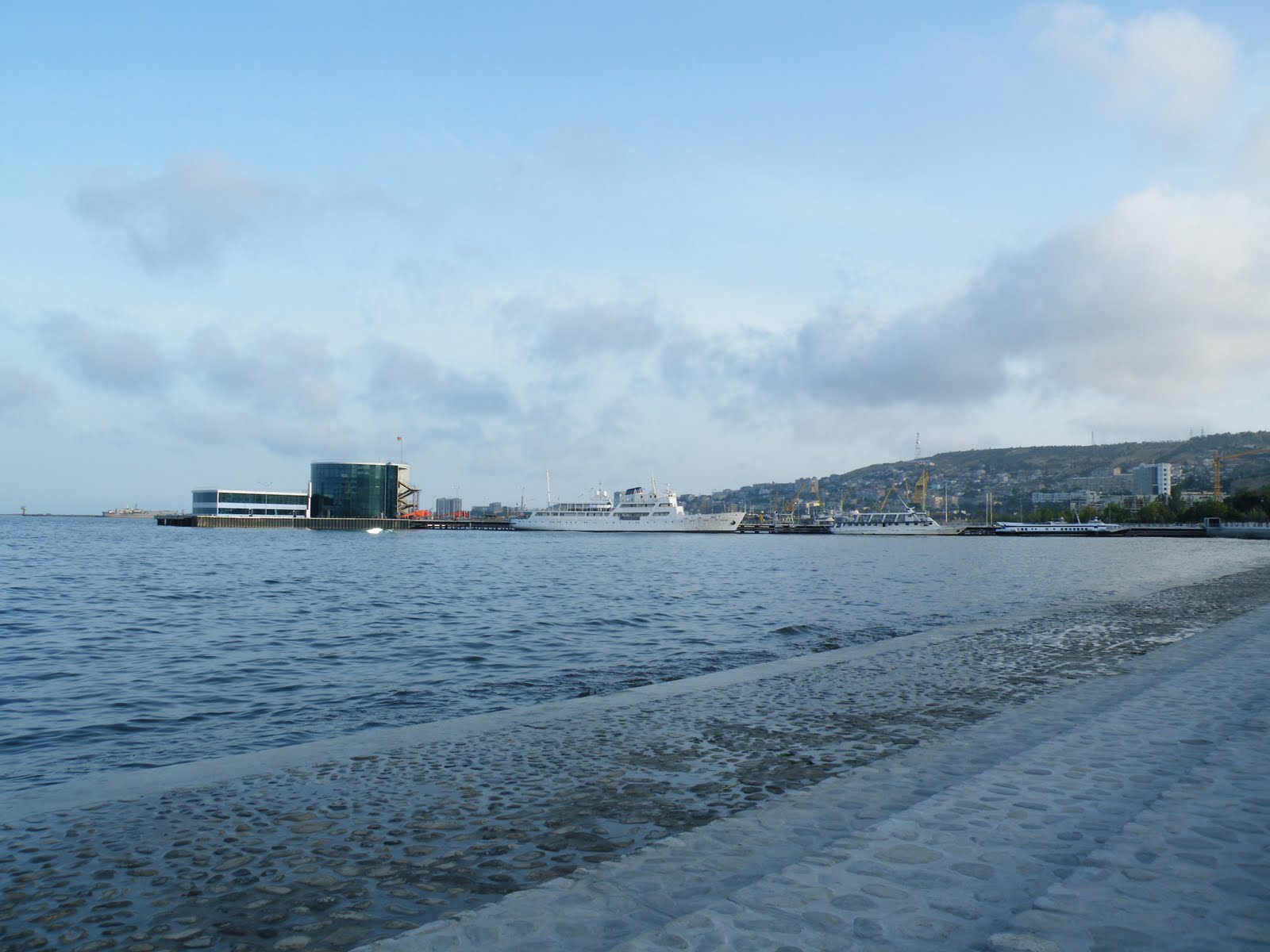
I've reached the Caspian Sea! I haven't seen the sea for a very long time so it's good to be back by the water. Even if said water carries a certain oily sheen. Baku has been an oil boom town for over a century, and boy does the landscape around the city show it. I believe the correct adjective is "dystopian". I am apparently going to have a lot of time to appreciate it, as the next ferry to Aktau in Kazakhstan is unlikely to leave until Friday or so. The concept of timetables or schedules for this kind of transportation has yet to catch on here.
Azerbaijan has been a pleasant surprise so far. I was extremely grumpy about having to leave Tbilisi with its coffee shops and wireless hotspots and dilapidated European architecture and khachapuri and plum conserve for a country which I expected to be expensive, time-consuming and tiresome (an impression based, entirely unfairly, on my experience of getting the bloody visa, but six separate embassy visits can do that to a person). And then I spent my first night in a tiny village eating the greatest dolma in the world because I'd met a girl on the bus, and the second at the best hotel in the next town being wined and dined for absolutely nothing, because her father knew someone. Good going, Azerbaijan!
Something I've really missed: Central Asian grannies, lurking under their multicoloured headscarves, sweet and innocent right up until the alcohol comes out and you find that the words "No thanks, I think I've had enough!" have no meaning for them. Still, mulberry vodka is pretty damned good *collapses*
Subscribe to:
Posts (Atom)