Friday, February 19, 2010

Xayr O'zbekiston, yakshi qo'ling


Tomorrow morning I'm leaving on what I hope will be a six month trip through Turkmenistan, Iran, Pakistan, China, Kazakhstan, Kyrgyzstan, Tajikistan and back to Uzbekistan. Getting the visas was such a performance that it became an end in itself, and now I have a passport full of stickers it's begnning to sink in that oh crap, I'm leaving tomorrow. Now the thought is almost overwhelming: I have Persepolis and Isfahan and Kashgar and the Hindu Kush all before of me, and I am so excited and terrified that I can hardly breathe.

I've no idea what it's going to be like; I've never travelled alone for such a long period before, and although I'm reasonably confident of my ability to handle most things these places may throw at me, I'm a little worried I may find it all too mentally exhausting and crash after a month or two. Except this is what I've been dreaming of for years, and I've lived on my own for a year in one of the most frustrating and ridiculous countries in the world (I love you, Uzbekistan, but good Lord, you don't make it easy), and I've just spent a week in Afghanistan (this did seem like a sensible idea at the time), and now is not the time to wuss out. I can do this.

It is, however, a great shame that the buildup to epic journeys has to be ruined by bloody packing. Marco Polo was strangely silent on this point (mind you, things would be a lot easier if I had my own caravan of camels). My backpack capacity seems to decrease every time I use it.

Friday, February 5, 2010

Premier league buzkashi


I am (still) recovering from a new year spent in Bukhara, primarily being fed. New year is the most important winter festival here, and, like all good festivals, involves family and food in large quantities. Just when you’ve finished three courses and are eyeing the fruit bowl and contemplating whether there is in fact a polite and non-messy way to eat a pomegranate, out comes the fourth, and then you sort of want to die. In an attempt to prevent myself from sinking into a mutton-and-oil-induced stupor (a recognised medical condition in Central Asia), I’ve been spending the weekends stomping around the mountains (Tashkent has had a disappointingly mild winter, with only a couple of desultory snowfalls, but the weather in the mountains certainly make up for it). Given that flailing around in waist-deep snow loses its novelty after a while, I jumped at the chance to spend a day with some friends at a village which was hosting a championship of that most Central Asian of games, known variously as ulaq, kukmar, kupkari and kuk-boru. Never heard of it? Yes, you have. You know, the one with the dead goat? Yeah, that one.

The Tajik name (buzkashi) translates, more or less, as “grab the goat”, which pretty much sums the whole thing up. A goat is slaughtered and the head removed; the carcass is then soaked in cold water overnight to toughen it. The next day, several dozen horsemen assemble and fight over it. I think there’s a method for goal scoring in there somewhere, but lets face it, that’s not especially important when you are engaged in serious horseback wrestling. Enjoyed primarily by the historically nomadic Kyrgyz, Kazakh and Tajik people (indeed, Kyrgyz evening TV schedules give pride of place to a buzkashi Match of the Day, complete with interviews inarticulate players, grumpy managers and overly groomed commentators), my announcement that I was going to a game was met by blank looks by my Uzbek colleagues, who eventually admitted that this might be something that “those weird people in the mountains do”. Indeed, the playing field was a plateau set in a mountainside outside a village miles from anywhere, almost on the Tajik border. We were deposited by our rickety-lada-driving taxiste on an icy footpath, and immediately had to fling ourselves out the way of a hundred or so horsemen hurtling past on a detour from the field of play. Rule one of buzkashi seems to be that the game is wherever the goat is.

The spectators had ranged themselves across the hillside among dozens of makeshift barbeques and snowdrifts sprouting cooling vodka bottles. The horsemen (and yes, they were all men) ranging in age from six to sixty (and the rule was not necessarily one man, one horse) hurtled around the field below, caked in mud and slush. Every so often, the guy with the goat would decide that playing on the field was cramping his style and make a beeline directly up the hill towards the onlookers, forcing everyone to make a run for it, scattering fur caps, empty vodka bottles and spare goats in all directions. Over the chaos, the commentators, aided by a monumental sound system the looked as though it had been patched together from several dozen car radios, kept up a breathless, multilingual commentary. As a group containing the only two women in attendance, our presence attracted a certain amount of excitement and we were immediately invited to introduce ourselves on the sound system and tell everyone how much we loved Uzbekistan (a lot, obviously) and drink a toast to international friendship.

The four of us wandered around taking photos and dodging stray horses, offers of dinner and marriage, and people who were keen to show us their photo album of their horses which they had named after Premier League football teams. The game (or games - someone assured me that several teams came and went, but I really couldn’t tell the difference) went on all afternoon, and as the sun went in it became bitterly cold, prompting the spectator to up their fortification with copious quantities of vodka, plov, shashlik and vodka. Since none of us had really dressed for subzero temperatures, we were by this time all too happy to accept all of the above, and the proceedings rapidly became pretty merry. Eventually, a team (or person? I really never got the hand of the rules) and they (or he?) were awarded an extremely irate-looking eagle as their prize and everyone stumbled back down the hill, carrying the prone bodies of their friends who had medicated against the cold too liberally or received a knock on the head from an over-enthusiastic goat-chaser, only stopping for one final vodka-fuelled picnic in the snow at the bottom of the valley. By this time we were firm friends with Premier League Horse Guy, so we retreated to his brother’s house to defrost and drink toasts to love and international friendship and horses named Arsenal and so on. I have no memory of how we got back from the mountains, but those who were alive to the particulars of our chauffeur’s driving on the icy roads assure me that this is a good thing. Sometimes one is happier not knowing.

Anyway, drunk driving aside it was something I was glad to have experienced, because my time in Uzbekistan is rapidly drawing to a close. In a couple of weeks I'll be heading to Turkmenistan (fingers crossed for the most awkward visa in Central Asia) and Iran (headscarf-tying practice in progress), so every day at the moment is an exhausting mixture of hanging around in embassies perusing prmotional leaflets exhorting me to consider the investment opportunities inherent in the Pakistani towel industry and visiting every nook and cranny of Tashkent I could never be bothered to before (Hello, museum of cotton-picking, can't think how I missed you!). And for those of you who asked, pictures (including buzkashi) are (finally) here.

Sunday, December 27, 2009

Christmas hike


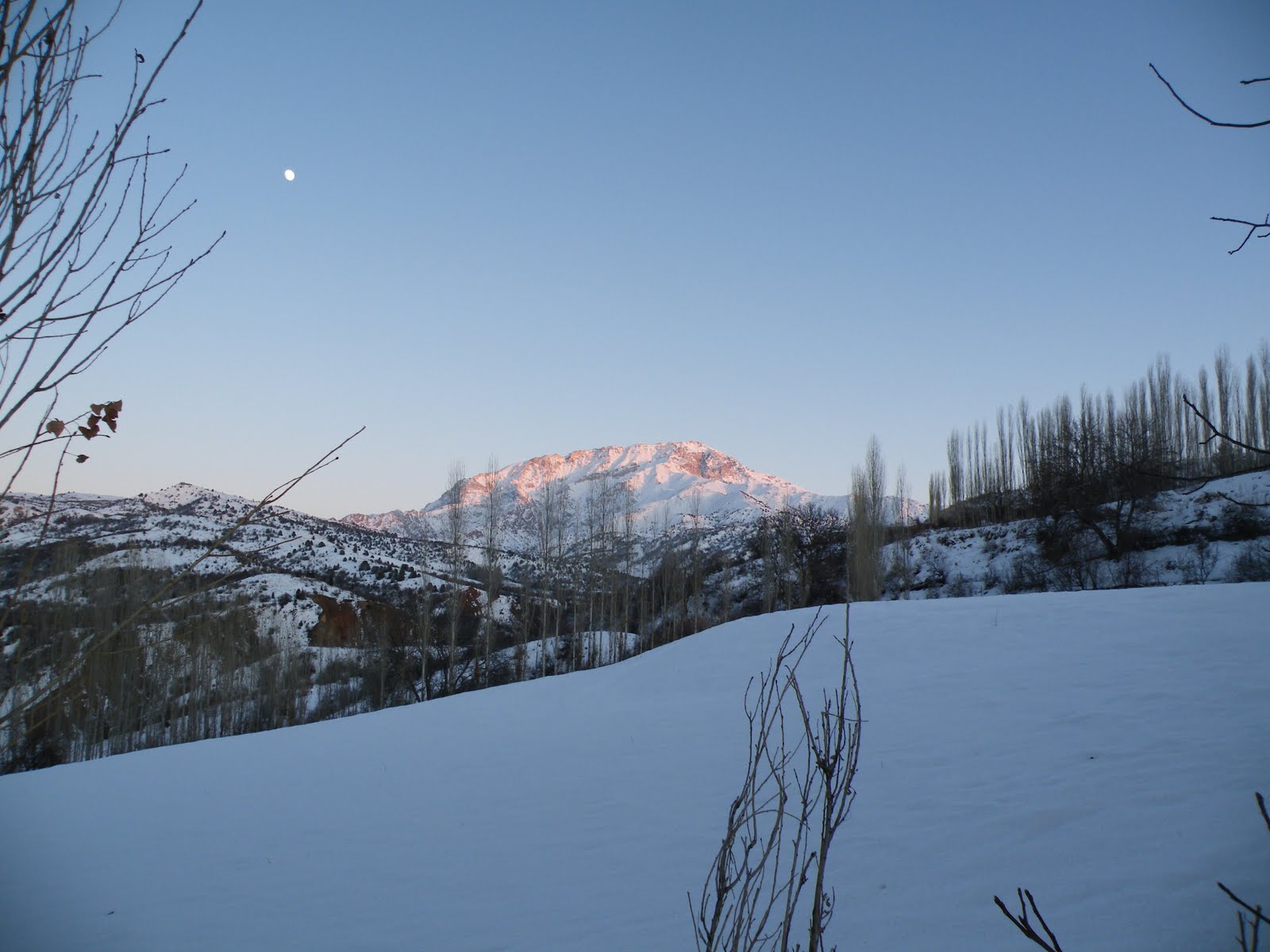
We have not had much in the way of snow in Tashkent this winter. The mountains around us have had quite a lot. Nothing, however, deters our hiking guide, the indomitable Boris (on the left, wearing the bright pink fleece. He pulls it off.), and we wade over the hills of a Sunday afternoon with great intrepidity. The Boxing Day Brisk Walk (TM my mother) is the one Christmas tradition I've managed to hang on to here, so I owe Boris for that.

Sunday, November 29, 2009

Thursday, September 10, 2009

Kyrgyz hospitality unleashed in all its muttony glory


Since Tashkent was persistently failing to honour the "get colder" part of autumn, I fled, as soon as I was decently able to Kyrgyzstan, about which I knew little but that it was high, and therefore cold, and that it had to be better than dusty Tashkent with its sputtering fountains and artificially green flowerbeds that serve only to emphasise the dryness of the air. I believe it was at the point at which I was stuck in the middle of a blizzard on the ascent to a 4000m pass, clinging frantically to my horse as it floundered through snow up to its chest that the thought occurred that perhaps there were less uncomfortable ways to escape. Surrounded on all sides by the massive peaks of the Tien Shan range, I felt that such a setting deserved slightly better than my flailing. One hundred and fifty years ago, British and Russian spies disguised unconvincingly as Turkmen horse traders were sneaking through these mountains, vigorously intriguing against each other all the while, and now here I was, trying not to fall off my horse and feeling utterly incapable of even the smallest intrigue. I couldn’t help feeling that I was lowering the tone of the landscape somewhat.

Kyrgyzstan is all about the majestic landscape: over 90% of the country is at an altitude above 1500m and nearly 50% is over 2500m. Lacking the picturesque crumbling masonry possessed in such abundant quantities by Uzbekistan, the country sells itself on a combination of its spectacular scenery and the traditional hospitality of its people. For centuries the Kyrgyz lived an entirely nomadic lifestyle, tribes pitching their yurts together and moving on every few months or so. The Soviets more or less put an end to this, but since independence many rural families have resumed a semi-nomadic existence. Come May or so, the yurt is loaded onto the top of the Lada, and everyone heads with their livestock to the jailoos, the beautiful and fertile alpine pastures that sustain the sheep and cows which are the livelihoods of these people. By the end of September, everyone heads back down again, but for those few months yurts cluster like mushrooms across the hills and mountains, by lakes, up tiny valleys, anywhere there is water and good grazing. Many families have decided that tourists seeking an Authentic Nomadic Experience are a better bet than sheep, so once you leave the unlovely cement streets of Bishkek, the capital, you are swept up into the hills and into a yurt with almost indecent haste. Fortunately, we are all here for the yurts, and from my viewpoint in a yurt by a mountain lake that would have been no doubt absolutely lovely but for the rather Welsh weather, I too was able to observe “Kyrgyz hospitality unleashed in all its muttony glory!” as one of the more enthusiastic local brochures put it.

Said hospitality is genuine, effusive, and generally involves much discussion of everyone’s marriage and children (potential children will do if you are lacking in this department, but this is considered letting the side down) conducted over copious quantities of food and drink, among which the prime culprit is the dread beverage kumis. Kumis is fermented mares milk and tastes exactly as awful as it sounds. It is mildly alcoholic, with a smoky, beery, rancid taste and an effect on the unwary digestive system that can only be described as unfortunate. It is the drink of welcome in a yurt, and one cannot stop anywhere without being presented with a large bowl of the stuff, which you have to at least attempt out of politeness, although finishing it is a risky business as it will immediately be refilled. I developed a kind of love-hate relationship with the stuff, and became unable to stop myself from sampling it at every opportunity, because I could never believe it was quite as horrible as I remembered (it always was). Much better is the Kyrgyz cream tea - fresh bread (cooked in a large saucepan on top of a stove, a technique which I never managed to get my head around), fresh cream and home-made jam. Oh, and tea. Pots and pots and pots of tea (I counted an average of about eight bowls per meal, which translated to about five or six mugs). When your water source is the stream you share with your herds of cows and horses, it is undeniably a better idea to rehydrate with tea as opposed to unboiled water, but yurt tea is usually served with sugar, condensed milk or jam (occasionally all three) which can be a little overwhelming. The Kyrgyz phrase the visitor is most likely to leave with is the stern “choy ich!” - drink tea! - that greets any protestation that one has had enough to drink. This is before even one gets to the muttony part (the primary ingredient of all Central Asian cuisine is mutton fat, and it remains a mystery to me how everyone here doesn’t die of heart disease before they’re thirty), and the upshot is that if you are me you end up huddling under a pile of blankets clutching your stomach, wishing you didn’t feel quite so full and vowing never to have any children.

After a few days of muttony hospitality, I was left feeling in dire need of a more active way to appreciate the scenery. Parked as I was in a lakeside yurt camp, I was thinking vaguely along the lines of a one day amble on horseback along the shore; however, by a combination of circumstances, the exact details of which escape me but I’m pretty sure involved a bottle of vodka, I found myself together with a charming British couple accompanying the guides and packhorses of an organised hiking tour (now disorganised and soaking their feet in the lake) 150 miles back home over the mountains. The vodka had naturally put paid to any qualms about our collective lack of horse riding experience and Russian language skills the previous night, but in the cold light of day the mountains looked steep, the horses were clearly unimpressed, and the guide had clearly taken my cautious venture that I speak “chut-chut pa-Russki” as admission of complete fluency. We struggled up that first ridge gasping fish-like in the thin air, with the guides more or less having to drag our horses who had not signed up for riders on the return leg of their journey, and were making their feelings clear. By the time we reached the top, I was more or less ready to call it a day and would’ve happily abandoned the horses to find their way back on their own, except that from the top you could see nothing but the lake stretching away towards one snow-capped mountain range after another, and nowhere could you see any habitation or sign of life apart from a herd of sheep clinging to a precipitous hillside, and it felt like we were the only people in the world. Which was actually a pretty good feeling, so we rode on.

For the next few days we rode along valleys, scrambling over ridges and up barren, stony morraine and across glaciers melting quickly in the late summer heat and unpleasantly prone to collapsing ice bridges, and over the steep, icy passes and back down again, galloping in slapdash formation across hillsides bright with wildflowers and air thick with bees and butterflies, and down, down, back to the treeline and then through pine-covered canyons until the valley broadened out into wide pastureland cut by a lazily meandering river, and a cluster of yurts sending trails of smoke into the chilly evening air. We stayed with farmers and eagle hunters (erm, they hunt with eagles, rather than hunting the eagles themselves. The golden eagles circling overhead in a picturesque manner gain a slightly more threatening air when you have spent a cheerful evening being shown a photo album full of pictures of the WOLVES which the eagles have killed ON THEIR OWN) in their yurts, nursing our blisters over tea, kumis and bowls of laghman (noodles in mutton soup). One night, I struggled out of the yurt at midnight (the combination of too much kumis, a cavalier approach towards the use of water purification tablets and the local remedy of five shots of vodka laced with pepper (NB I cannot emphasise enough how much this does not work, although it undeniably takes one’s mind off things) was proving a little much for me) and literally gasped aloud, because I didn’t know it was possible to see so many stars. There was no hint of an electric light for miles, but the stars were bright enough to cast shadows, highlighting the silhouettes of the mountain peaks surrounding me. In the morning there was frost on the ground in the shadows of the yurts and the cows loomed out of the mist like ghosts as the sunrise turned the mountaintops pink, and I thought that I had never been anywhere so beautiful in my life.

Just writing that is making me feel less than happy that I am in grimy Tashkent again, and the view out of my window is of grubby apartment blocks rather than rolling mountains. The school I wwas working at has been closed, so I am somewhat at a loose end at the moment, and Tashkent is more or less entirely the wrong place to be at a loose end in. Since the only other option seems to be joining the cotton harvest (the cotton picking season is beginning, where the universities shut for a month or two and the students are sent out into the cotton fields to bring the harvest in) and this sounds rather like hard work, I am dashing off to see the rest of the country to put off making a decision about what to do next. Procrastination forever!

Friday, July 31, 2009

Notes from the golden road


I am writing this at the uncivilised hour of 6.30 am, sulking slightly about the fact that once again my alarm clock has been pre-empted by Tashkent’s unique version of a wakeup call. This is provided by a group of ladies who come into town every morning, bringing fresh dairy products from the countryside which they sell from old coke bottles by the side of the road on which my block of flats is located. I would ordinarily not object to this entirely harmless activity, but these ladies have failed to endear themselves to me by their habit of standing under my window and advertising their wares. Being woken daily at 6 am by bellows of “QATTIQ! QAIMOQ!” (Uzbek for “yoghurt” and “cream”. Say the sound “k”. Now say it again, except imagine you’re being sick halfway though. Congratulations, you’ve just pronounced the Uzbek letter “q”.) does nothing for my mental state, and I have not yet been able to overcome my ire (nor mild hygiene-related concerns) to the extent necessary to actually sample their produce, although I am assured that a) it is delicious and b) I am coddling my digestive system. I am roundly mocked here for my Western tendency to buy most things (and all my meat and dairy) in the supermarket rather than the bazaar, but old habits die hard and I just can’t bring myself to be enthusiastic about a piece of sheep that has been lying about in this heat for any length of time.

It is indeed fearsomely hot (sorry, UKers). Just as I had found myself beginning to think of the 35 C heat “Hey, maybe I could get used to this!” and to be certain that the apologies I was receiving about it being “cold for the time of year” were windups, the thermometer has started hitting 40 on a regular basis, and I have begun to research jobs with the British Antarctic Survey. The only way out of town at the weekends is to recruit a group of friends and hop on the excruciatingly slow, sweltering and uncomfortable train full of formidable Uzbek matrons piqued because you are sitting in their preferred seat, to the mountains out of town. The scenery is undoubtedly attractive, but I would still be there like a shot even if they resembled Slough because crucially the temperatures are 10 degrees lower. The border situation in the area is tortuous enough that a wrong turn at the top of a mountain is liable to send one into an entirely different country, lending an element of interest to proceedings, especially when said proceedings are mapless. Consequently, our expeditions are somewhat hit or miss - sometimes we find ourselves climbing through air thick with black and red butterflies up a hill spread with purple and yellow wildflowers, past Kazakh herders in their summer yurts and gushing waterfalls and it is heavenly. At other times, we accidentally end up in barren, steep-sided valleys with no obvious paths other than scree slopes, leading to ascents that fill your boots with gravel and descents of the kind where you are happy to throw yourself gratefully into a thorn bush as otherwise you are liable to slide off a 60 foot precipice, and it is slightly less heavenly but undeniably invigorating. Variety, as they say, is the spice of life

A couple of weeks ago I took the (sadly no longer golden, more tarmac really) road to Samarkand, the capital of Timur’s continent-spanning empire. During the late fourteenth century it was the centre of the world with the architecture to prove it. Its fortunes waxed and waned over the subsequent centuries, but the name has never lost its allure, and certainly it is today billed as Uzbekistan’s greatest tourist attraction. Samarkand is a place that has loomed so large in my imagination for so long that I was almost afraid to visit since it seemed inevitable that reality would not quite live up to my elaborate, camel-filled imaginings, and so it proved. While Bukhara looks like a silk road town that just happens to contain a TV mast and a football stadium, Samarkand looks more like a Soviet town that just happens to contain a Timurid Experience theme park. That’s perhaps a little harsh, but I felt a bit let down by Samarkand’s star attraction, the Registan (and if you don’t know what this looks like, do a Google Image search for “Samarkand Registan” - it really is undeniably impressive, an ensemble of three beautiful medrassehs surrounding a large square that used to be the commercial centre of the city). It looks exactly like it does on the postcards, and is glittery and shiny and beautiful and appears to only have been constructed the previous day. Which it more or less has, and therein lies the problem. The buildings have been restored so enthusiastically that you can no longer feel the weight of years, the accumulated history that gives these places their power to move. The impression that one is standing in the middle of an elaborate, yet somewhat rickety (most of the minaret towers are leaning in a manner that makes the Tower of Pisa appear a masterpiece of precision engineering) film set for a multi-million dollar epic starring Russell Crowe as Timur and Angelina Jolie as his feisty, ass-kicking concubine (whatever, you know he had one) is reinforced upon peering inside the medrassehs and at the reverse of the facades - freshly whitewashed rooms and plain brick walls that aren’t really meant to be looked at. It’s hard to believe that students ever studied here. A sense of place is restored somewhat among the tombs and mausoleums of Shah-i-Zinda, but even there the brand-new tilework left me only with a vaguely sacrilegious urge to retile the bathroom. A small museum nearby has a display of photos from a century ago which I found myself looking at rather wistfully. Then the structures were derelict, domes half-collapsed, with weeds growing in the courtyards and donkeys tied under the teetering porticos; undeniably more picturesque and romantic than the current reality, but in truth the monuments have been restored and rebuilt numerous times over the past six hundred years so there’s nothing particularly unauthentic about the current efforts. On balance I think it is probably rather better that attention is lavished on these places than not (especially if the alternative is to leave them to rot entirely), but the Hollywood effect is an unfortunate consequence. Although that said, I'm prepared to admit that my disappointment may owe as much to the lack of camels as to anything more profound. Note to tourism officials: CAMELS MAKE EVERYTHING BETTER..

Right, off to work now, avoiding localised flooding (Tashkent is kept lush and green by a battalion of sprinklers, in which the water pressure is so high that the tops often pop off, resulting in geyser-like eruptions which render any journey by foot slightly hazardous), in the hope that there will at least be working air conditioning there. I can manage, I think, another couple of weeks of this before I make a break for Kyrgyzstan, which has the enormous advantage of consisting almost entirely of mountain and (whisper it) I even heard a rumour that it’s sometimes necessary to put a coat on in the evenings. I can hardly wait.

Tuesday, May 19, 2009

Bukhara: medrassahs, marriage and mulberries


At the moment I am passing my time with my attempts to navigate my way through the forest of suffixes and particles which is the Uzbek language, picking up on the way jolly little sentences such as “Malika and Karima are silkworm breeders” and “Does your elder brother labour in the cotton fields today?”. I cannot but seriously respect a language which not only contains a “future tense of doubt” but also a “past tense of hearsay”. It is also full of sounds that English-speakers (well, me, anyway) appear to be quite incapable of producing (mostly extremely guttural variants of the letter K) that leave one with a very sore throat after a two-hour lesson. I am however in no position to complain to my friends here about the quirks of Uzbek, since they communicate with me primarily in English or French (now there’s a language the knowledge of which I did not think would come in handy in Uzbekistan, but the most plentiful breed of tourist here is indeed French, which make it popular for Uzbeks to learn) which in many cases is their fourth language (the other three generally being Uzbek, Tajik and Russian). Apparently I need to man up and reach for the strepsils.

To make my language problems worse, I’ve spent the past few days in Bukhara, 600 km south-west of Tashkent, in a part of the country where locals primarily speak Tajik (a Persian language very similar to Farsi), thus rendering my efforts largely useless. This is fine, though, since Bukhara itself is fantastical enough not to require very many words, and one need merely wander around in a happy haze of architectural pleasure and satisfaction that some places exist that live up to, and even surpass, their hype. It was once said that while everywhere else on earth light shone down from heaven, from Bukhara it shone up, and even now you can almost believe it. Bukhara was an oasis along the Silk Road and for hundreds of years one of the centres of the Islamic world. It shows in the extravagance of the architecture, and the skyline of the old town is a mass of blue domes and intricately decorated medrassas against a background of mud brick, dominated by the 48m high Kalon minaret, from the top of which condemned criminals were sewn into a sack before being thrown to their deaths (unnecessarily messy, I should’ve thought, but I suppose that was why they used the sack), and where at night a fire was lit to guide the camel caravans in. 19th century players of the Great Game seemed divided over whether Bukhara was a den of iniquity and vice or a wonder of the world, but I tend to come down on the latter side. I think the buildings here are the most beautiful I have ever seen.

Many of the monuments are undergoing extensive restoration, a process which seems to involve covering them with scaffolding and then leaving one solitary bloke to vigorously attack what looks to my untrained eye like a beautiful and irreplaceable piece of tilework with a sledgehammer. Given that the results are universally impressive and shiny, I assume there is a bit more to it than that, but I think it’s a bit of a shame that almost everywhere seems to have received this treatment. It’s almost a disappointment to approach a beautifully restored medrassa only to realise that all it contains is the 47th carpet shop you have encountered that day plus a one-room museum to which you will be charged $1 entry and your camera $3; much more atmospheric are the ruined and empty medrassas and mausoleums which dot the back streets of the old town, or the lively and vigorous bazaars that still operate in the ancient covered markets. In spite of this, though, there really aren't that many tourists, and sitting at a tea house by one of the ancient pools that used to provide water (plus accompanying plagues) to the city eating fresh mulberries from the trees that are shading you, you could almost believe that nothing had changed for the past four hundred years. It would have been even better if there had been a token camel or two around, though.

My experience of Bukhara was made several times better by the fact that I was staying with a friend and his family, and thus got my first chance to experience what I had been told many times was the legendary hospitality of the Uzbek people first hand - something else that lives up to its reputation. Suffice it to say that I don’t think I need to eat again for a month or two. I was enthusiastically fed, watered (well, tea'd, which seems to be the equivalent here) and guided around town by a large selection of friends and relatives all of whom were unfailingly friendly, welcoming and immediately invited me to their homes too. I also got a chance to dwell at length on a subject which appears to be dear to the hearts of many Uzbeks. Regardless of whether an encounter takes place in the bazaar, someone’s home or on the top of a deeply rickety and vertiginous water tower (don‘t ask), and depending on the level of my communicant’s English or French, the conversation always goes more or less as follows: who are you, where are you from, how old are you, where’s your husband, what do you mean you‘re not married, why not, what about your sisters, they aren’t either, dear me, doesn’t your mother want grandchildren (Dear Mum, please do not get any ideas), have you thought about marrying an Uzbek man, what about my son/my nephew/me etc. People marry young in this country - girls at 17 to 20 and guys about three to five years older - so I’m rapidly reaching my sell-by date in that regard, hence many people’s surprise at my single status. I’ve pretty much resigned myself to living a kind of “Lost in Austen” existence here, with my primary goal not to end up married to somebody’s cousin by the end of the year. I have to admit that a certain amount of my motivation to learn Uzbek stems from a fear that I might accidentally agree to something like this simply by nodding too enthusiastically at the wrong moment.


I’m back now in Tashkent, which, bless it, is no Bukhara; thus I am again plotting my next expedition out of town. During my time in Bukhara the weather back here has veered abruptly from monsoon to oven, and I’m seriously considering making burnt offerings to my air conditioning unit if that will encourage it to secrete even a small quantity of genuinely cold air from its increasingly creaky innards . I am reliably informed that things are only going to get worse come June. “Even”, said a student of mine with a certain gloomy relish, “the Tashkent Aquapark will not save you then”. Now, if you’ll excuse me, I have to go find a fountain to camp out in