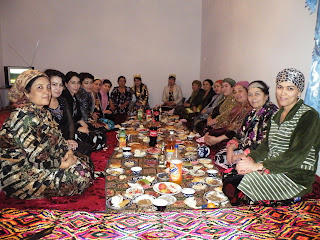
 Above: Uzbek ladies know how to party! Correct technique for a bridal welcome party: dump the boys in a skanky dark room to drink vodka and be manly, then assemble in a huge room with delicious food and even more vodka. Eat food, drink vodka. Repeat. The two ladies sitting at the far end of the table are the brides.

So, I think I have been extremely remiss so far in devoting little or no commentary to the wonders of Central Asian cuisine. Possibly that's because "wonders" is a bit of a strong word. The food here is often delicious but, as I may have mentioned once or twice before, the base elements of the local food constitute mutton and, well, mutton fat. Sheep are prized for the size of their booty (the specimen on the left sports a particularly fine example) and fatty meat is much more expensive to buy than lean. The results can politely be described as "hearty", and you quickly become closely acquainted with the very special sensation of congealed mutton fat coating the roof of your mouth. And while home-cooked food is almost inevitably great, restaurants haven't really got the hang of variety, so you can easily find yourself carefully rotating the same four or five meals over and over again in order to avoid eating
plov for two straight meals in a row and thus losing the ability to move for the next forty eight hours.

Flavouring is bizarrely hit-or-miss. The most commonly-used herb is dill, in what seems to me to be unecessarily large quantities; garlic makes an occasional appearance and while there might be a hot and spicy sauce on the table if you are lucky, the food in general errs on the side of blandness. Everything is served with bread, round, cooked in a clay oven andspectacularly moreish when fresh, less so when stale or made with mutton fat (no, seriously. In
everything.). Vegetables are rather an afterthought although salads can get quite creative (too often drowned in mayonnaise though); fruit on the other hand is so good in season that I don't think I'll be able to bear going back to stuff we get at home.
In summary: artery-clogging is actively encouraged, and vegetarians need not apply (I've met one or two dedicated souls attempting to cross Central Asia without eating any meat - they were to a woman rather wild-eyed). Below is a selection of the Central Asian (well, mainly Uzbek, but there's not a whole lot of difference) greatest hits. Breathe deeply, wash everything down with plenty of green tea and think about how well your stomach is being lined for the forthcoming vodka toasts.
 Plov:
Where better to start than with the king Central Asian cuisine, that exquisite mixture of rice, mutton fat, carrot, mutton
fat and a tiny bit of mutton, plov. This almost approaches a religion in Uzbekistan particularly, where among other things it is invoked as an aphrodisiac (personally, I can't imagine how you could possibly be up for anything after a plate of plov, but then again, I'm not Uzbek, and the birthrate here is undeniably high). A good home-made plov is delicious, studded with entire bulbs of garlic and heaps of mutton and carrots; unfortunately the restaurant variety can often end up swimming in half an inch or more of oil. I am going to unpatriotically admit that I prefer the Afghan variety, which isn't cooked in oil.
 Laghman
:
Laghman is my favourite of the local standards: thick Chinese-style handmade noodles, served either in a soup or dry with on top. At its best, it is spicy and garlicky and full of aubergine and peppers and tomatoes and limited mutton fat. At its lukewarm, flavourless worse it is still approximately 47% less likely to leave you prodding the roof of your mouth with your tongue and wondering if drinking nail polish remover would dissolve the fat coating than every other dish listed here.
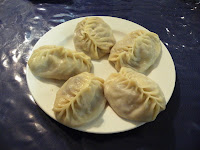 Manty:
These are huge meat dumplings, usually steamed but sometimes fried. Often delicious but very easy to overdose on, especially when an enthusiastic hostess is urging you on, so much so that I can barely look them in the eye any more. The pumpkin versions (autumn only) are spectacular, only somewhat less so once you are aware that they, too, have been enlivened with handfuls of mutton fat.
 Shashlik:
Nothing can be quite as good, or quite as bad, as meat on a stick. From Iran to Kazahstan, of an evening the street corners are alive with miniature barbecues with an attendant vigrously fanning the smoke, and the smell of roasting meat is everwhere. Usually alternating cubes of mutton and (you guessed it) mutton fat; I personally prefer the whole lot minced up together which is a) tastier and b) you can pretend that what you are eating isn't 50% fat.Served with lots of raw onion and (naturally) bread.
 Shorpa:
Meat and potato soup, often with bonus lumps of fat floating in it. I tend to associate it with dismal roadside cafes during long-distance bus journeys where it is often the onlything served and can thus take it or leave it. Usually rather tasteless, but can be absolutely superb when homemade. I think that this one wasn't that bad actually.
 Halim
:
Meat porridge. Um. It's not quite as bad as it sounds (although admittedly this isn't hard)?. It's more
unexpected than anything else.
Still to come (when I assemble the photos): drinks, snacks, desserts (such as there are. Likely to be a love letter to the fruit here). In the meantime I am off to take full advantage of the fact that I'm in a capital city and shamelessly stuff my face with pizza which may be of questionable authenticity, but is 100% guaranteed not to contain any mutton fat at all. Score.
 Dawdling in Kyrgyzstan is an almost entirely pleasant activity, even if its object (to wait out the violence down south) is somewhat less so. The reason for this is primarily because it is so easy to engage in said time-wastage in yurts up in the Kyrgyz mountains, which flicked in a day from spring to summer - morning drizzle gave way one day to bright afternoon sunshine that hasn't let up since. With this in mind, I coralled a trio of Swedes (travelling with Swedes is great: you learn the best Norwegian jokes) and we hired some horses and a guide to disappear for a few days into the hills in the centre of the country, where yurts sprout like mushrooms and there are ibexes (how do you properly pluralise an ibex? ibices?) on the mountain ridges and marmots (not marmosets. This caused a certain amount of confusion for a while) running shrieking at your approach.
 I really can't get enough of the mountains here. Even when the horses are intransigent (Kyrgyz horses know damned well that foreign tourists have imbibed too much animal-welfare nonsense to follow the single piece of advice that constitutes riding instruction in these parts ("just hit it") with much conviction, and take full advantage of this, with the result that you frequently find yourself stationary in a patch of wildflowers for extended periods of time with the horse stuffing its face and you prodding it cautiously the whip, vaguely worrying that an RSPCA inspector is going to pop out from behind a rock and do you for animal cruelty, while the guide disappears over the horizon. Or possibly that's just me.) and the "saddles" appear to have taken their notion of comfort from a medieval torture chamber, everything feels fresh and bright and clean, with the high still covered with spring flowers and dozens and dozens of meltwater streams running off the hills. Wandering around the valley one evening I suddenly remembered what one is supposed to do when faced with a multitude of small streams and a large supply of flat stones and mud, and spent a very happy couple of hours damming and diverting several streams, and anyone who doesn't fully appreciate how supremely satisfying an activity this can be is probably dead inside.
 Unlike the last time I was horse trekking here, this time we weren't particularly going anywhere, so we would do a bit of riding in the morning to get some nice views, then come back to the yurt, which is always very much a working place as well as somewhere for tourists to crash, so there were always small armies of daughters and nieces (it seems that a lot of families in the towns send their children to relatives in the country for their summer holidays so a lot of the kids up here now actualy spend most of the year in Bishkek) milking the cows and horses and making cream and fetching water and cooking, while the sons and nephews herded the goats and the cattle and we rather got in the way, but everyone was very nice and fed us neverending quantities of tea and kumis anyway (ah, kumis. The one (monumental) downside to yurt living. Have I waxed lyrical on the subject of fermented mares' milk before? Oh, I have. If someone in a yurt offers you a large bowl of slightly suspect-smelling white liquid with... bits floating in it, proceed with caution (see post immediatley below this one). I don't want anyone to say they weren't warned).
 One afternoon, our host invited the neighbours (i.e. everyone who had a yurt within two hours ride) over for the Kyrgyz equivalent of a kickabout, which of course meant an enthusiastic game of kok-boru, the Kyrgyz national game which can be described as polo with a higher body count and which is played with the carcass of a goat. Compared to the full village-on-village clash I watched earlier this year, this was a more modest though no less chaotic affair, with half-a-dozen guys on each team as opposed to two hundred but an equal reluctance to confine the action to the pre-agreed playing field and feeling that nothing has been achieved until someone has been carried off unconscious (he woke up again in time for dinner, so that was OK). In the evening we ate goat kebab and fresh bread and cream and wild cherry jam by the light of oil lanterns while the Anglo-Swedish contingent strove to find an acceptable excuse for refusing the fourth bowl of kumis ( a partial list of what hasn't worked so far: I'm sick, it's against my religion, I'm lactose intolerant, I'm pregnant) and convincing defense for the inexplicable fact that despite the fact all of us were unmarried, none of us were imminently planning to rectify the situation, and the mountains turned pink in the sunset. I don't understand why everyone doesn't do this.


